
What happened and why it matters
Project Hail Mary, the film adaptation of Andy Weir’s bestselling novel, lands as a hopeful, oddly tender space adventure that leaves audiences with an ambiguous but emotionally resonant ending — and a puppet sidekick who steals nearly every scene. The movie is now playing in theaters, and it raises immediate questions about Ryland Grace’s fate, the state of Earth, and how filmmakers brought Rocky the alien to life.
Who, what, when, where
Directed by Phil Lord and Christopher Miller and starring Ryan Gosling as Dr. Ryland Grace, Project Hail Mary follows one lone astronaut racing to save the sun from a life-draining microbe called Astrophage. Grace teams up with Rocky, a rocklike alien from the planet Erid, and together they engineer a microorganism (nicknamed Taumoeba) that consumes Astrophage and can revive stars.
The film ends with Grace unable to return to Earth immediately because of fuel and uncertainty about the world he left behind. In the movie — as in Andy Weir’s book — Rocky’s people build a beachfront habitat on Erid to protect Grace from the planet’s crushing gravity and toxic atmosphere, and they even make a classroom where he can teach Earth science. Weir told Entertainment Weekly that Rocky tells Grace, “Hey, we can fuel up the Hail Mary now, and you can go home,” but Grace hesitates because he doesn’t know what awaits him on Earth.
How bleak is Earth?
The film briefly shows probes returning to Earth and depicts a cold, diminished planet. Weir has suggested that, two decades after the Astrophage crisis began, the planet is likely badly damaged and that famine and population loss are plausible. The screenplay stops short of defining exactly how many people remain; the novel’s epilogue, however, makes clear that Grace and Rocky spend their lives together on Erid.
Bringing Rocky to life
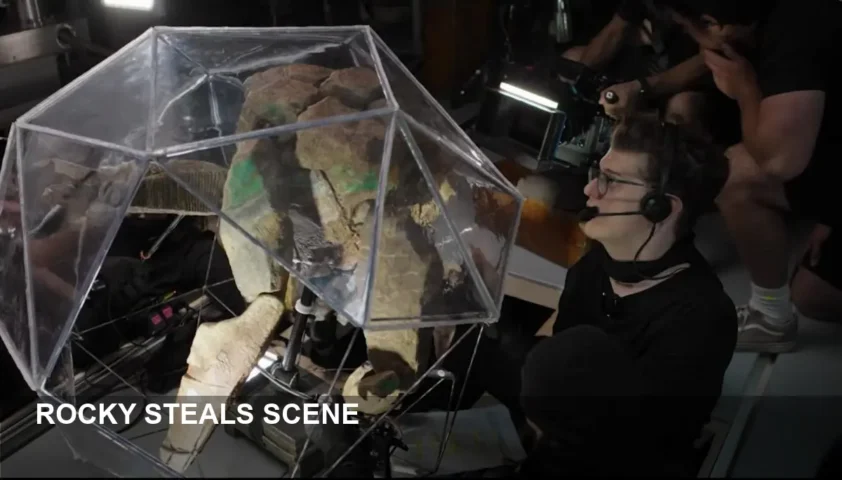
Rocky is not a CGI companion but an elaborate animatronic puppet performed on set by veteran puppeteer James Ortiz. Ortiz — known in theater circles for large-scale creature work — operated the creature during Gosling’s scenes, giving the actors a tangible presence to react to and helping capture a warm, physical chemistry on camera.
Critics and audiences have noticed that Rocky’s real-world presence pays off: the creature’s quirks and gestures feel immediate, which underpins the odd-couple friendship at the heart of the story.
Critical reaction and context
Reviewers describe Project Hail Mary as a big-hearted, family-friendly science-fiction adventure with a slightly uneven tone. At 156 minutes, Lord and Miller’s film mixes nerdy in-jokes and physical gags with high-stakes space drama, a balance some critics praised and others found uneven. Still, many point to its optimism — and Gosling’s affable performance — as reasons the movie is easy to root for.
What’s next
The movie currently ends on an open question: will Ryland attempt the long journey home? From Earth’s perspective the return trip would be about 16 years; from his perspective, relativistic travel compresses the duration to roughly four to five years, Weir noted. The author declined to outline any sequel plans, and the film leaves the choice unresolved — giving audiences the bittersweet final image of two friends on an alien shore and the implication, via the novel’s epilogue, that they remain together.
For now, audiences can judge for themselves: Project Hail Mary is in theaters, blending science, sentiment and a standout puppet performance that’s already a talking point among moviegoers.