
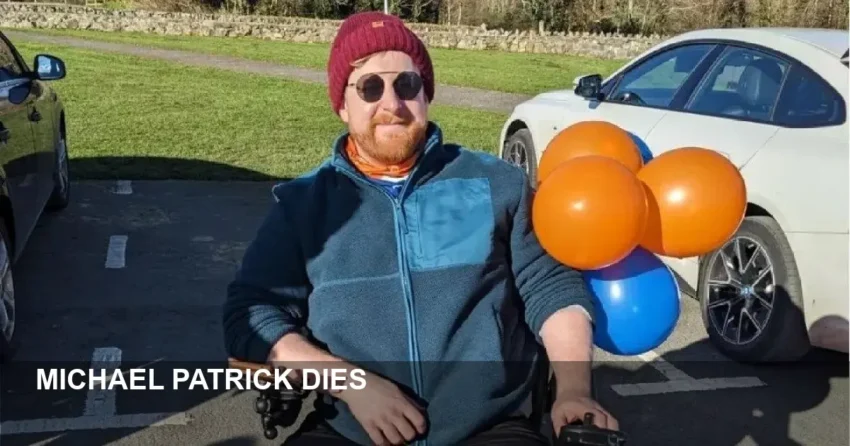
Michael Patrick died on April 7, 2026, his wife Naomi Sheehan announced on Instagram the following day, confirming the 35‑year‑old actor and playwright had lost a three‑year battle with Motor Neurone Disease. His wife wrote that “He passed peacefully, surrounded by family and friends,” and thanked hospice staff for their care.
Patrick — who had a memorable turn as a Wildling in season 6 of Game of Thrones and wrote the stage piece My Right Foot about his illness — first noticed problems while performing at the Dublin Fringe in late 2022. He was formally diagnosed with MND on 1 February 2023 and later revealed he carries a familial FUS gene variant linked to inherited cases of the disease.
He entered a clinical drug trial in 2023 and reported small but meaningful improvements: within weeks he said he could wiggle his right foot for the first time in years and saw partial reversal of breathing symptoms, an outcome he described as “really exciting” on a January 2026 podcast. Yet by February 2026 he decided against a tracheostomy after being told staffing shortages would likely keep him hospitalized for months, and he chose to focus on specialist home and hospice care instead.
Patrick and his supporters launched a public fundraiser late in 2025 to help cover specialist care; the campaign surpassed its initial six‑figure target, a sign of the strong community backing he had as his condition progressed.
What does this loss mean beyond one family? His case — a young performer with a familial FUS mutation who briefly improved on an experimental therapy — underscores both the progress and the limits of current MND research. It also highlights a recurring problem in advanced care: access to post‑operative support (and the staffing needed to provide it) can determine whether patients opt for life‑extending procedures or choose comfort‑focused care instead.
Fans and colleagues reacted across social platforms after Sheehan’s Instagram post, sharing memories of Patrick’s laughter and generosity. Theatre friends praised his work as a writer-actor who used humor and honesty to bring attention to a devastating disease; others pointed to the clinical trial note as evidence that experimental medicines can produce meaningful symptomatic changes even when a cure remains out of reach.
Timeline, in brief: symptoms emerged during a late 2022 stage run; diagnosis came in February 2023; trial enrollment and initial improvement followed in 2023; the decision not to pursue a tracheostomy was announced in February 2026; hospice care began ten days before his death on April 7, 2026, and Sheehan publicly confirmed his passing on April 8.
Patrick’s family has asked for privacy as they make funeral and memorial plans. For the MND community, his public account of living with a FUS‑linked form of the disease — and the short-lived gains from experimental treatment — will likely feed advocacy for faster access to targeted therapies and better staffing for post‑operative care (a practical gap that affected his final choices).