
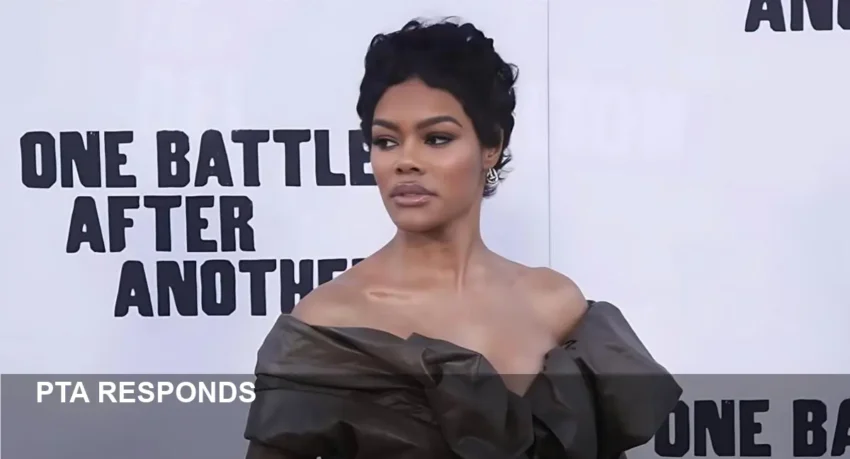
Paul Thomas Anderson broke his silence on the controversy around his Oscar-winning film One Battle After Another during a post-Academy Awards press room appearance, saying the depiction of Teyana Taylor’s character was an intentional, complicated choice that ties into the movie’s generational story.
What Anderson said at the Oscars press room
After the film collected six Oscars, including Best Picture, Best Director and Best Adapted Screenplay, Anderson addressed questions about Perfidia Beverly Hills, the revolutionary figure at the center of criticism for how Black women are portrayed in the film.
“I know a little bit about that critique. I know that Teyana has talked about it a lot,” Anderson said, adding that Perfidia is “so flawed and, unfortunately, makes decisions that are detrimental to the revolution that she’s trying to fight.”
He described the choice as deliberate: “We always knew that we were trying to make something complicated. We knew that we weren’t making something that was heroic and we needed to lean into that.” Anderson also noted Perfidia’s mental-health struggles — saying the character was “suffering not only from postpartum depression, but she had issues of her own that she hadn’t really reconciled with.”
How the director frames the story
Anderson emphasized that Perfidia’s arc is meant to set up the film’s emotional center: the next generation. He pointed to Chase Infiniti’s character, Willa, as the inheritor of a fractured legacy and the one who must “try to do better.”
“The point of it is to set up a story of Willa, the next generation,” he told reporters. “What happens when your parents, who are damaged and have handed quite a difficult history to you — how do you manage that? That’s our story. Our story is in Chase, and her evolution, in terms of the generational aspect.”
Context: awards, roots and reaction
One Battle After Another arrived with a huge awards-season run, taking top prizes from the Golden Globes, BAFTAs, Critics Choice, the WGA, DGA and PGA before its Oscars night haul — which also included Best Supporting Actor (Sean Penn), Best Editing (Andy Jurgensen) and the inaugural Best Casting award for Cassandra Kulukundis.
Despite the wins and rave reviews, debate over the film’s racial dynamics has been persistent. Critics and some audience members argued that moments in Perfidia’s story — including how motherhood and postpartum depression are presented — were overshadowed by scenes that felt exploitative or insufficiently explored.
Anderson had largely stayed quiet on the issue through awards season, making this post-Oscars press room comments his most direct engagement with the controversy to date.
Fan and industry reaction
The remarks are likely to sharpen conversation rather than end it: observers say awards recognition tends to amplify scrutiny, and the film’s controversial choices will be reexamined in essays, panels and social feeds.
On the other hand, the movie’s success has sparked renewed interest in Paul Thomas Anderson’s filmography. Almost every PTA film is available across streaming platforms, letting viewers revisit earlier work as they debate the new film’s themes and intentions.
What comes next
Expect the conversation to continue — from awards-season retrospectives to critical essays and public responses from cast members. Anderson’s comments frame Perfidia as an intentionally imperfect, tragic figure whose downfall is part of a larger tale about legacy, responsibility and the next generation’s attempt to “do better.”
With the Oscars now in the rearview and the film widely seen, audiences and industry watchers will be watching for follow-up interviews, essays and discussions that dig deeper into representation, authorship and the responsibilities of storytellers when a movie becomes both a cultural event and an awards phenomenon.