
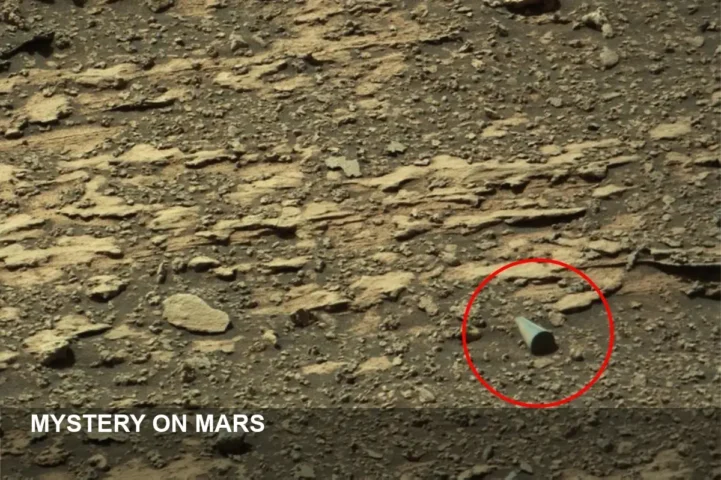
A small, cone-shaped object captured on Mars has reignited debate over whether Curiosity should be sent back to investigate — and why a single photograph can still prompt big questions about the Red Planet.
What was spotted, and who raised the alarm?
The object, roughly 20 centimeters long with a flat base and a glossy appearance, appears in a photograph taken by NASA’s Curiosity Rover in 2022 in Gale Crater near Mars’ equator. Harvard astrophysicist Avi Loeb drew fresh attention to the image in a March 8 Medium post, asking whether the rover should return to examine the find rather than assuming it is human-made debris.
Where the object sits in the mission context
Curiosity is currently working on the slopes of Mount Sharp, and the flagged item lies about five miles from the rover’s present position. The machine has been exploring Gale Crater since arriving in 2012, collecting images and geological data that continue to fuel analysis and debate.
Why experts disagree
Reaction has split between cautious curiosity and mundane explanations. Loeb and others argue that any unidentified object deserves a closer look, given public funding for the mission and the scientific value of resolving anomalies. He wrote that the most likely explanation is human-made debris but still urged prioritizing a direct investigation.
On the other side, some researchers note the rover itself or mission hardware could have produced the object — for example, a piece of shed equipment — and that many unusual shapes on Mars turn out to be natural or mission-related items once examined up close.
How the object was found
The image was initially flagged by amateur Mars researcher Rami Bar Ilan and brought to wider attention by Dr. Jan Spacek of the Foundation for Applied Molecular Evolution. That sequence — from hobbyist to academic to a prominent scientist — highlights how public archives and social media continue to surface fresh questions from long-standing mission data.
Public and social reaction
Loeb’s post reignited online discussion among space enthusiasts and skeptics alike. Posts and threads pointed to everything from optical illusion to hardware fragments, illustrating how a single photo can generate wide-ranging theories. NASA has not publicly identified the object or confirmed whether it will task Curiosity to revisit the site.
What happens next?
- NASA’s formal response: none yet — an official identification or decision to redirect Curiosity has not been announced.
- Potential rover action: commanding Curiosity to drive roughly five miles would require mission resources and planning; the scientific team will weigh those costs against current objectives.
- Public interest: as seen here, amateur researchers and scientists will continue mining Curiosity’s image archive for anomalies.
Also in the headlines
In unrelated pop-culture news as of March 14, pop star Bruno Mars topped the U.S. album chart with The Romantic. The coincidence of names — Mars the planet and Bruno Mars the artist — briefly amplified social chatter, but the scientific question about the Gale Crater object remains distinct and unresolved.
For now, the cone is another reminder that even routine mission imagery can spark fresh scientific questions and public debate. Observers are watching to see whether NASA will prioritize a targeted investigation or record the item as likely mission-related debris.