
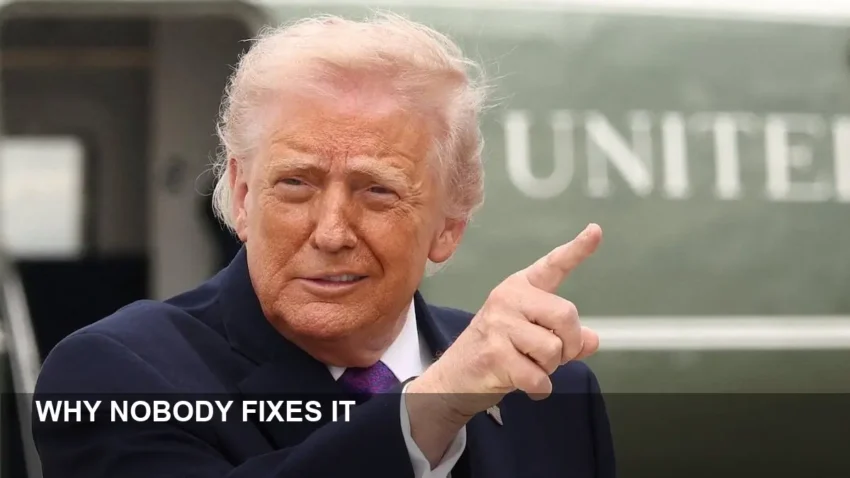
Three very different scenes — a president repeatedly using the wrong word, uncertain counts at the U.S. border, and game designers arguing over difficulty — share one surprising throughline: in each case, “nobody” seems willing or able to fix the problem. That absence of correction or certainty can have real consequences, from public messaging to national security to how players experience a game.
The politics of correction: Trump’s ‘excursion’
President Donald Trump has been using the word “excursion” dozens of times to describe a military action in Iran, even as aides and reporters say the intended term is likely “incursion.” Several administration officials told reporters they avoid correcting him — either because it would be futile or because it could provoke a negative reaction — creating a small but visible breakdown in language and public briefing.
Reporters also tried to press the issue on the record. One asked the president, “You just said it is a ‘little excursion,’ and you said it is a ‘war.’ So, which one is it?” The exchange underlines how even a single misused word can create confusion about the scale and intent of U.S. action.
Unknown numbers at the border: why ‘nobody knows’
On a very different stage, journalists and analysts are grappling with uncertainty about how many people entered the U.S. undetected during recent years. Media reports and think tanks offer different tallies for Iranian nationals encountered at the southwest border: one outlet put the number at about 1,504 during 2021–2024, another group reported roughly 1,650 encounters, and some coverage said 729 Iranian nationals were caught and later released into the country.
Those gaps—paired with disputed “apprehension rate” claims—produce a persistent refrain: nobody knows the full picture. Reporting has also highlighted smuggling routes, document-forging networks in hubs like São Paulo, and law-enforcement actions such as an ICE roundup that reportedly arrested 11 Iranians in June 2025, including people with possible militant links. The discrepancy in data matters because it shapes policy debates about border security and vetting.
Game devs and the impossible balance: why ‘nobody’ nails difficulty
At the Game Developers Conference, Obsidian senior systems designer Robert Donovan explained the trade-offs behind The Outer Worlds 2’s difficulty tuning — and why satisfying every player is essentially impossible. Testers and reviewers were split: some found the game too hard, some too easy, and some “just right.” Donovan summed it up bluntly: “No matter what we changed, somebody was going to get mad.”
Obsidian moved to a “hits-to-kill” mindset and focused on getting Normal difficulty to feel meaningful, accepting that highly engaged players will always break balance with optimized builds while more casual players need readable progression. That compromise echoes the other two stories: when stakeholders and audiences vary widely, no single fix pleases everyone.
What unites these cases — and why it matters now
Across politics, security and entertainment, the common thread is structural: people defer correction, data are incomplete, and designers must choose trade-offs. The result is public confusion, policy vulnerability, or divided audiences. Expect continued scrutiny — reporters and analysts will press for clearer numbers at the border, watchdogs will monitor official language about military actions, and developers will keep iterating on difficulty options and post-launch patches.
In short, “nobody” stepping in isn’t just a quip — it’s a pattern with consequences. The immediate ask for readers and stakeholders is the same: demand clearer language, better data, and more flexible systems that admit trade-offs while striving for transparency.