
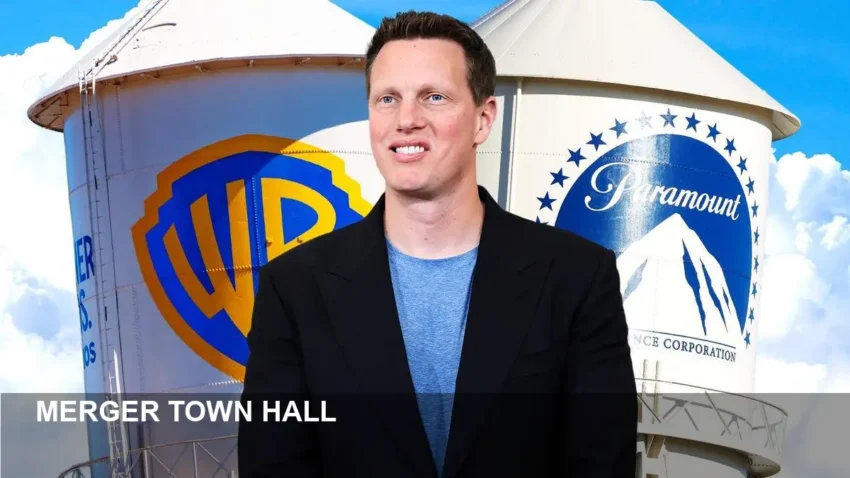
David Ellison, the Paramount Skydance CEO whose company won a $111 billion bid for Warner Bros. Discovery, made his first major appearance at the Warner Bros. lot this week — telling staff the “turbulent” bidding process is behind them and outlining early plans that could reshape film and streaming output.
Town hall at the Warner Bros. lot
Ellison spoke at the Steven J. Ross Theater in Burbank before roughly 160 in-person executives and more than 300 staffers tuning in remotely. Warner Bros. Discovery CEO David Zaslav introduced him, and the session included studio and TV leaders such as Pamela Abdy, Mike De Luca, Channing Dungey, HBO chief Casey Bloys, streaming head JB Perrette and DC Studios co-head Peter Safran.
He opened by acknowledging the tough bidding period — “I know the bidding process has been turbulent, but that’s all behind us now” — and spent about 10 minutes on high-level plans before taking a dozen questions in a Q&A moderated by WBD communications head Robert Gibbs.
Key takeaways: films, costs, CNN and streaming
- Thirty films a year: Ellison reiterated Paramount’s goal for the combined company to produce roughly 30 theatrical titles annually — about 15 from each studio. IMAX CEO Rich Gelfond later told broadcasters Ellison was “adamant” about hitting that target.
- Cost savings: Ellison said the merger could deliver as much as $6 billion in synergies but declined to estimate how many jobs might be cut, noting legal and regulatory limits on detailed pre-close planning.
- HBO and CNN: He praised HBO as the “gold standard” in television and reassured staff that CNN would remain editorially independent.
- Streaming future: On questions about combining HBO Max and Paramount+, Ellison said he planned to consult the teams at both services before mapping a strategy.
How executives reacted
Attendees described Ellison as “honest and direct,” with one senior executive saying “it was good there were no surprises.” Paramount executives reportedly received positive feedback on his breadth of industry knowledge. Still, some staff wanted more specificity on layoffs and the new operating structure — details Ellison said he could not provide during the pre-merger “gun-jumping” period.
Why this matters now
The meeting comes after Netflix exited the bidding war and Paramount topped its rival with a raised $31-per-share offer. Paramount expects the acquisition to close in the third quarter of 2026; the company has agreed to a 25-cent-per-share ticking fee for every quarter the deal isn’t completed after that point.
Industry watchers are watching closely: a merged Paramount–Warner Bros. could increase theatrical output, reshape streaming consolidation plans and trigger cost-cutting similar to past studio mergers. For audiences, the near-term change will be limited — executives must still navigate regulatory reviews and integrate large teams before new release schedules or streaming bundles are finalized.
What to expect next: more meetings between creative and streaming teams, regulatory filings and, as Ellison put it, a continued focus on bringing the companies together without “surprises” as the deal moves toward its expected Q3 2026 close.