
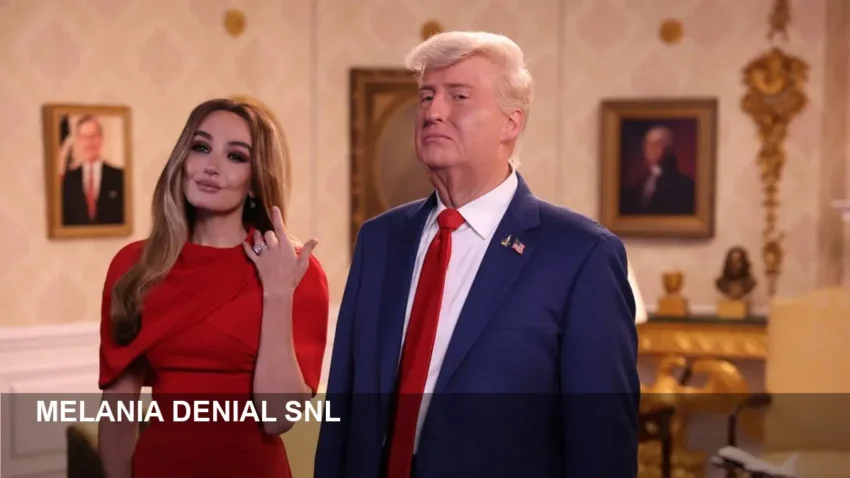
Saturday Night Live opened its April 11 episode with a cold open mocking Melania Trump’s surprise White House address, turning a disputed personal denial into late-night fodder almost overnight. Using the presidential podium to settle private questions rarely shrinks scrutiny — it institutionalizes the dispute and magnifies it, often beyond the speaker’s control.
In a short televised statement from the White House on Thursday the first lady flatly denied any relationship with Jeffrey Epstein or his associate Ghislaine Maxwell, calling the circulating images and claims “lies” and urging Congress to hold public hearings for Epstein’s victims. She also characterized a 2002 email to Maxwell as “casual correspondence.” President Trump told MS Now’s Jacqueline Alemany he had not known about the address ahead of time; a separate White House source later indicated senior staff were aware.
Hours later SNL opened with a sketch that sent up the timing and tone of that speech. Chloe Fineman played Melania, James Austin Johnson portrayed the president and the cold open leaned into the absurd — suggesting, in joke form, that the first lady considered issuing other out-of-the-blue declarations to avoid suspicion. The sketch folded the remarks into a wider roundup of headlines and pushed the conversation onto social platforms, where clips quickly circulated.
Public reaction has been split. Crisis communications consultants say the address behaved like a textbook Streisand effect: an attempt to silence rumor that instead turbocharged searches, scrutiny and social media debate. “The more specific the denial, the more specific the headline,” one PR specialist noted — and the email signed “Love, Melania” has become a focal point for commentators and cable hosts alike.
On MSNBC’s Morning Joe, co-host Joe Scarborough called the speech “beyond bizarre,” questioning why the first lady would bring up such explosive material now and noting that the sign-off on the 2002 note felt unusually warm for a purely casual exchange. He, like others, asked the question many viewers are asking: was the address meant to preempt a developing story, or did it invite one?
Lawmakers and legal watchers have reason to pay attention. The first lady asked for congressional hearings to hear Epstein’s victims — a move that could open new lines of inquiry (and new rounds of document requests). Separately, a subpoena-driven episode involving a former official’s handling of related records is already on the calendar and may feed the news cycle further.
What this episode underscores is that when private associations are denied from a podium that symbolizes public power, the denial itself becomes news. Late-night satire will keep amplifying the storyline, cable will keep debating intent, and online searches will keep turning up old images and documents — including that 2002 exchange — for weeks to come. Expect more scrutiny, more legal questions and more late-night riffs before the matter quiets down.